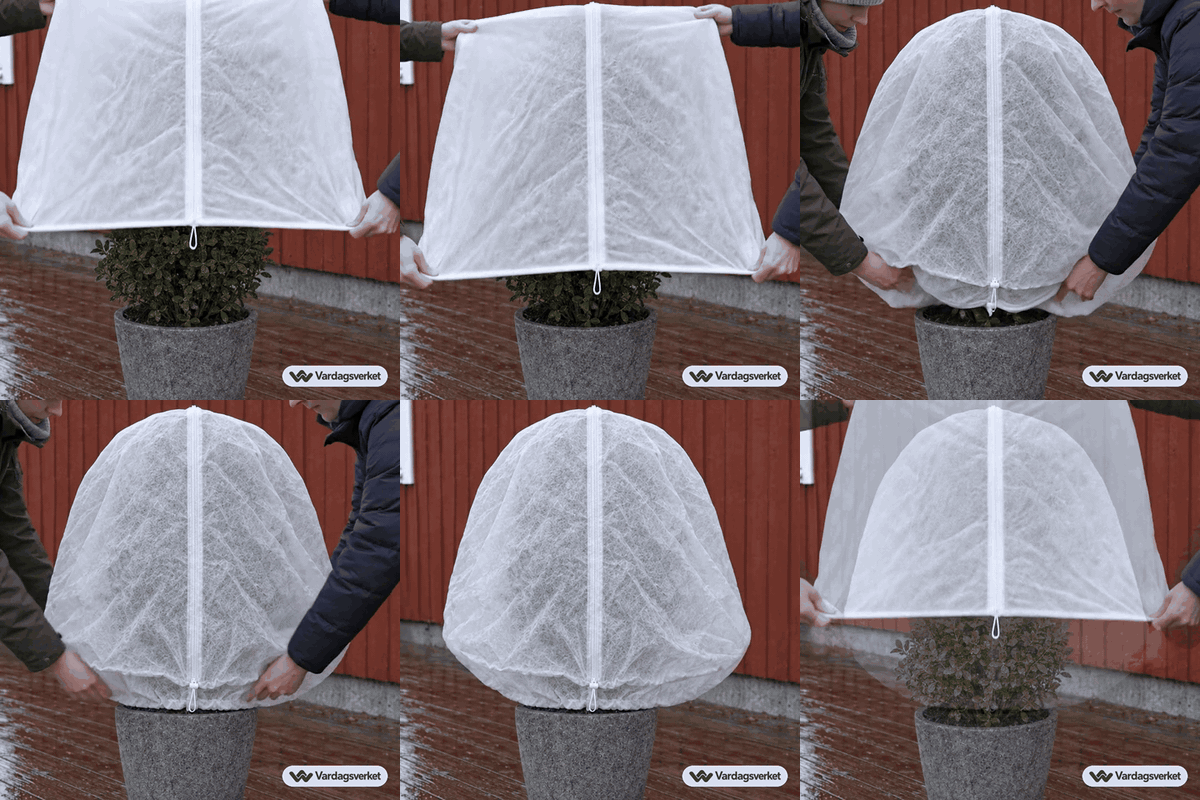
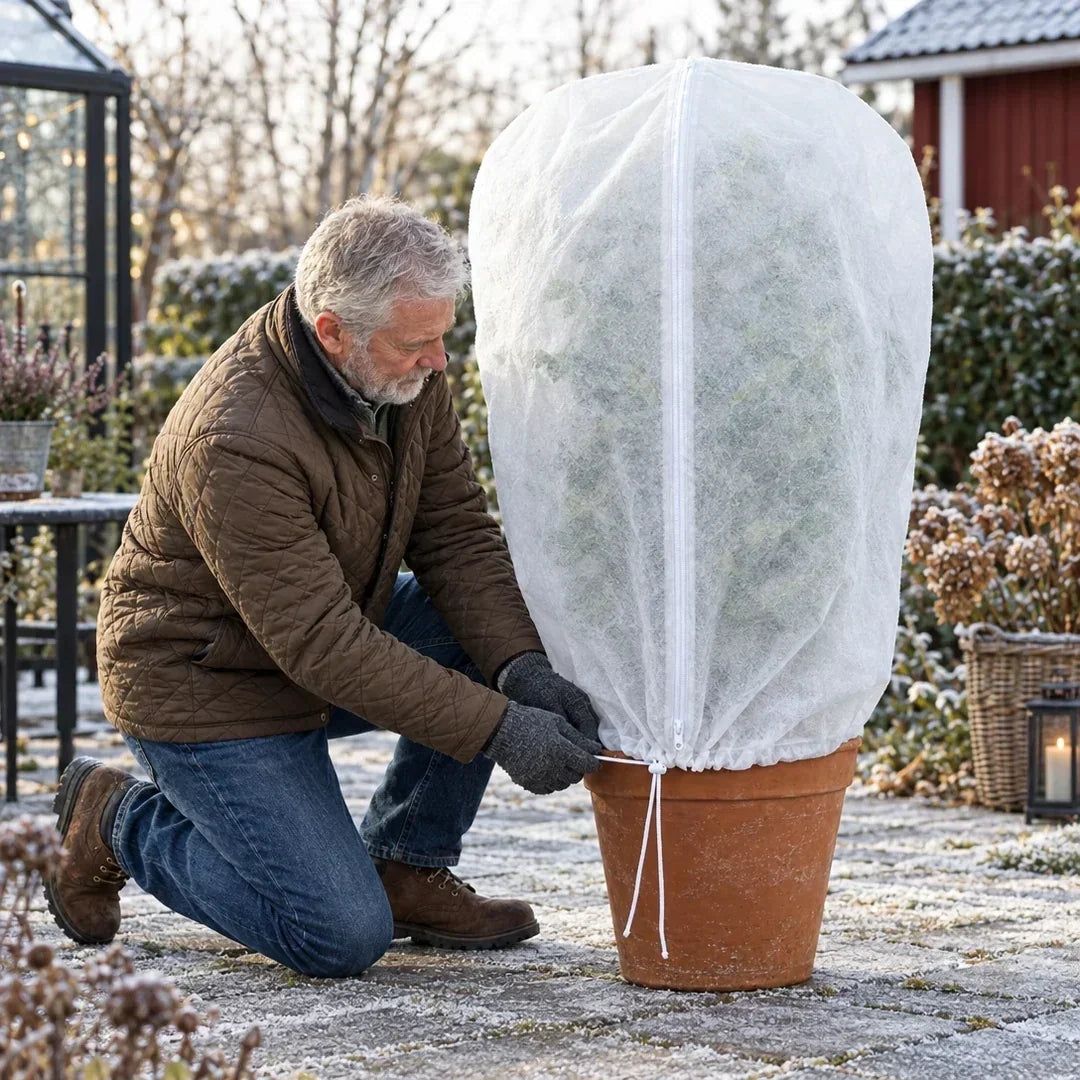
Horticultural fleece is a thin, airy fabric that you lay loosely over plants. It works like a light blanket. At night it holds on to some of the heat from the ground, and it softens the wind. That is often enough on a clear autumn night or a late frost in May. Against severe cold, and against spring sun on evergreens, it is the wrong tool.
How much does horticultural fleece protect against frost?
There is no Swedish measurement of how many degrees horticultural fleece gives. We haven't found any Swedish authority or research source that states a figure. The Royal Horticultural Society (RHS) says that thicker fleece gives roughly 2 degrees of frost protection. Treat it as a rough guide, not a guarantee. The protection depends on how cold the night gets, whether it is windy, how much heat the ground has stored and how thick the fleece is.
The closest thing to a Swedish measurement is a student thesis from SLU Alnarp, the Swedish University of Agricultural Sciences (Ljungberg and Svensson, 2014). They measured the temperature under different fleeces on two farms in Skåne, in southern Sweden, in April and May. On the coldest night the sensor without fleece showed −1.1 °C on one of the farms. The 30 g fleece and a double layer of 17 g fleece kept the warmth best then. The thinner fleeces let it escape faster.
The thesis's literature review says that fleece does not give full protection once it gets colder than roughly −4 °C, but that it can reduce the damage. So fleece is enough for light frost.
Can it get too warm under horticultural fleece?
Yes. The same thesis also measured sunny days. In late April it reached just over 48 °C under a 22 g fleece, against 36–40 °C without. The difference was 9 °C on one farm and 12.4 °C on the other. The trial was done on farmland, not on potted plants, but fleece traps the sun's heat in the same way over a pot.
The heat can help new sowings in spring but harms plants that should rest over winter.
Can you use horticultural fleece in winter?
Not on evergreens, meaning plants that keep their leaves or needles over winter, such as rhododendron, box and yew. The advisers at the Swedish gardening association Riksförbundet Svensk Trädgård (Svensk Trädgård for short) advise against fleece as winter protection for tender evergreens. The fleece traps the sun's heat and warms the plant up. Water in the tissue can then freeze on a cold night and burst the cell walls. The sun also makes the leaves lose water, and when the ground is frozen the roots can't take up any more. The plant dries out, which is known as winter desiccation. Brown leaves or needles between April and June are a sign of it.
The advisers recommend hessian or green shade netting instead. Cover mainly the side that gets sun. The hessian also softens the wind. The protection can stay on from just after New Year until around mid-April.
Deciduous shrubs have no leaves to dry out, but they too can wake too early in the warmth under the fleece and then be damaged when the frost returns.
Which horticultural fleece should you choose?
Svensk Trädgård asked amateur growers about their fleeces in its Trädgårdsspanarna ("garden spotters") project. The advice was to avoid the thinnest fleeces at 17 g/m² and to choose 22 g/m² or heavier. Thicker fleece lasts longer and insulates better against the cold. Cheap, thin fleeces got the most criticism, and some fell apart within four to eight weeks.
| Fleece | Light let through (manufacturer's figure) | Coldest night in Alnarp | Svensk Trädgård's advice |
|---|---|---|---|
| 17 g/m² | 85% | Let the warmth escape faster | Avoid, tears easily |
| 22 g/m² | 79% | Let the warmth escape faster | Lowest recommended weight |
| 30 g/m² | 75% | Kept the warmth best | Lasts longer, insulates better |
| 2 layers of 17 g/m² | Not stated | Kept the warmth best | No information |
The light figures apply to the fleeces in the Alnarp trial. Other brands may differ.
Does horticultural fleece let water through?
Yes, fleece isn't waterproof. Rain and a watering can both get through, and when growing strawberries people often water straight through the fabric. It also lets air and most of the light through, so it can stay over plants for several weeks in spring. Plastic doesn't breathe. Under a plastic bag the moisture stays in, and in sun it quickly gets hot.
When should the fleece go on and come off?
On: According to SMHI, the Swedish meteorological institute, frost most often forms when the sky is clear and the wind is light. Put the fleece on in the afternoon on days when the forecast shows a clear, cold night, while the ground still holds the day's warmth. Weather stations measure two metres above the ground, and at ground level it can be considerably colder. Low plants can therefore freeze even though the forecast shows temperatures above zero.
Off: Fold the fleece back when the sun comes out and temperatures rise above freezing. Over strawberries it should come off when they flower, otherwise bees and other insects can't reach the flowers.
In spring: Take the fleece off completely once the frosty nights are over. SMHI points out that the odd frosty night can come right into early summer and that the old farmers' calendar dates have no support in the statistics. Follow the forecast, not the almanac.
In autumn: The first frosty night arrives at different times in different parts of the country. According to a map from Swedish Television (SVT), based on SMHI data, it normally comes in early August in parts of Jämtland and Härjedalen in northern Sweden but not until late November along the Götaland coast in the south. With fleece over them, dahlias and late vegetables cope with the first light frosty nights.
Step-by-step instructions follow further down.
What is the best way to protect plants from frost?
It depends on the plant and the time of year.
| Protection | Best for | Keep in mind |
|---|---|---|
| Horticultural fleece on a roll | Beds, strawberries, new sowings and low plants in spring and autumn | Secure the edges and fold back in sun |
| Sewn fleece cover | Individual potted plants and shrubs during frosty nights and wind | Same material as the fleece, so open it up in sun |
| Hessian or green shade netting | Evergreens from New Year to April, and windy spots | Gives shade and wind protection, not warmth |
| Plastic bag | Emergency fix for a single night | Doesn't breathe, take it off in the morning |
For individual pots there are ready-made covers. Our Vinterhuv is a fleece cover with a zip and drawstring, which stays put in wind without clothes pegs. It follows the same rules as all fleece: open the zip or take it off on sunny days, and choose hessian for evergreens in spring sun.
You'll find more ways to protect pots in our guide Overwintering potted plants outdoors. Roses have their own tricks, such as earthing up and spruce branches, and we go through them in Winter protection for roses. You'll find more for the garden under Outdoor & Garden.
Common mistakes
- The fleece goes on only when it's already freezing. Put it on in the afternoon, while the ground is warm.
- The fleece is left on in blazing sun. In the Alnarp trial it reached over 48 °C under the fleece.
- Fleece on evergreens in February and March. Use hessian or green shade netting.
- The thinnest fleece, because it's the cheapest. 17 g/m² insulates worst and tears most easily.
- The fleece is pulled tight. Lay it loosely. A fleece pressing against the plants can damage them.
- The edges aren't secured. Then the fleece blows off or lets in cold air from underneath.
- The fleece is left to cope with severe cold alone. When the cold sets in, frost-tender potted plants need to come into a cool, frost-free room.
Sources
- Riksförbundet Svensk Trädgård, the advisers: Current questions, February (How do I protect tender plants?)
- Riksförbundet Svensk Trädgård: On hardiness
- Riksförbundet Svensk Trädgård: Trädgårdsspanarna, horticultural fleece results 2024
- Ljungberg and Svensson (2014): Crop covering with fleece and its effect on temperature and humidity, student thesis, SLU Alnarp
- SMHI: Frost and ground frost
- SMHI: Iron nights (early autumn frosts)
- SVT Weather: Normal date of the first frost
- Royal Horticultural Society: How to grow olives (horticultural fleece and frost)