A pillow should hold your head at a height where your neck is in line with your spine. That height depends on three things: how you lie, how broad your shoulders are and how far you sink into the mattress. That is why no single pillow suits everyone, however many tests you read.
By neck pillow we mean a shaped sleeping pillow here, also called an ergonomic pillow or contour pillow. This guide is about comfort, sleeping position and pillow height. If you have long-term problems, speak to your GP or NHS 111.
Should I have a high or low pillow?
It depends on how you sleep. IKEA sums it up like this in its pillow guide: side sleepers need a high, firm pillow, back sleepers a medium-height one and stomach sleepers a low, soft one. The table shows what you can check yourself.
| You mostly sleep | Pillow height | Firmness | What the right height looks like |
|---|---|---|---|
| On your side | High | Firm and steady | The pillow fills the gap between shoulder and ear. Your nose points straight ahead, neither down towards the mattress nor up at the ceiling. |
| On your back | Medium height | Medium | Your chin isn’t pushed down towards your chest and your head doesn’t fall backwards. |
| On your stomach | Low | Soft | Your head lies almost flat. A high pillow bends your neck backwards. |
| Change position during the night | Medium, or a pillow with two heights | Medium | The height works both in the position you fall asleep in and the one you wake up in. |
Your shoulders and mattress also affect the height. With broad shoulders, the distance between mattress and head is greater when you lie on your side, and then you need a higher pillow. A soft mattress pulls the other way: your shoulder sinks in, so the pillow doesn’t need to be as high as on a firm mattress. If you’ve recently changed mattress, your old pillow can suddenly feel wrong.
How do I know if the pillow is the right height?
The easiest way is to have someone look, or to take a picture with your phone, while you lie in your usual position. Seen from the side, your neck and back should form a roughly straight line. If your head hangs down towards the mattress, the pillow is too low. If it points upwards, the pillow is too high. How to do the test step by step is described further down.
Also look at your pillow when you wake up. If you’ve folded it double or tucked your arm under it, you have probably been trying to build up more height during the night. If you’ve pushed it away completely, it may be too high.
Memory foam, fibre or down?
The material decides how well the pillow holds its height through the night. A pillow that gets squashed gives the right height when you fall asleep and a lower height a few hours later.
- Memory foam: moulds to your head and neck and slowly regains its shape when you lift your head. IKEA describes memory foam pillows as particularly good for back and side sleepers. The height changes little during the night, so you get roughly the height you buy. Choose it carefully.
- Fibre (hollow fibre or microfibre): fluffy and easy to shape by hand. It flattens more than foam during the night, but you can plump it up.
- Down and feather: soft and mouldable, so it can be pressed down to a low height. According to IKEA, down can be less suitable for people with allergies.
How should you use a neck pillow?
The neck pillow should sit under your head and neck. Your shoulders stay on the mattress. Pull the pillow down so that it fills the space under your neck, but not so far that your shoulders end up on top of it.
Many contour pillows have a higher and a lower edge. There is no set right way round, so try both. The higher edge under your neck often suits lying on your side and the lower one lying on your back, but your body and your mattress decide.
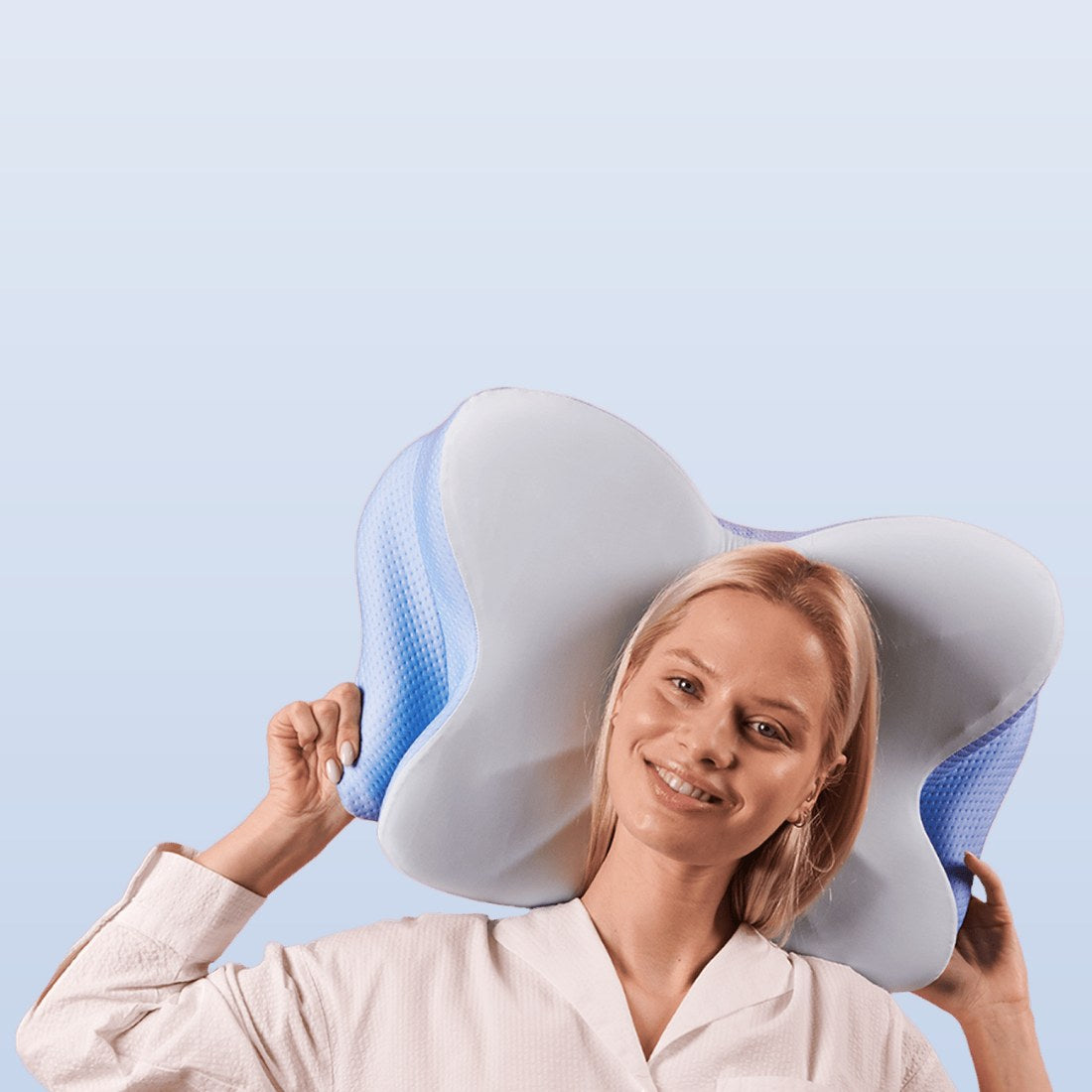
Our Nackvila is a butterfly-shaped memory foam neck pillow, 54 × 36 cm. It has a hollow in the middle for your head and support wings at the sides that fill the gap between shoulder and head when you turn onto your side. The shape is designed for back, side and stomach sleeping. If you mostly sleep on your stomach, do the phone test, since according to IKEA stomach sleepers need a low, soft pillow. You’ll find more things for the bedroom and everyday life under Home & comfort.
How long does it take to get used to a new pillow?
Allow a few nights. A new shape and a new height feel unfamiliar even when they suit you, especially if you’re coming from a flat or soft pillow. Sleep on it several nights in a row before you decide, and change only one thing at a time. If you change pillow and mattress in the same week, you won’t know what made the difference.
If the pillow arrives vacuum-packed, let it rest for a few hours after unpacking so the foam has time to regain its shape. Ideally, buy somewhere you can try the pillow at home and return it if it doesn’t suit you. Nackvila, for example, is covered by our 30-day money-back guarantee.
A travel neck pillow is a different product
If you’re looking for a neck pillow for the plane or train, you want the U-shaped travel pillow. It keeps your head in place when you sleep sitting up and isn’t made for the bed. If you spend a lot of time in the car or at a desk, comfort is more about the seat, and then you can read our guide to seat cushions for office chairs and cars.
Common mistakes
- Going by top-ten lists. A pillow that wins a test can be too high for you if you sleep on your stomach.
- Putting the pillow under your shoulders. That lifts your shoulders and your neck gets no support.
- Stacking two ordinary pillows. It easily ends up too high, and the pillows slide apart during the night.
- Forgetting the mattress. The same pillow gives a different height on a soft and a firm mattress.
- Giving up after one night. A new height and a new shape take a few nights to get used to.
- Believing promises that a pillow takes away aches and pains. Advertising rules say that marketing claims must be backed up by evidence, and the bar is particularly high for health claims. If you have long-term problems, speak to your GP or NHS 111.
Has your wooden headboard or bedside table picked up marks? Read how to repair scratches in wooden furniture.
Sources
- IKEA: How to choose the right pillow
- Konsumentverket: The Marketing Act for businesses
- NHS 111: 111.nhs.uk